


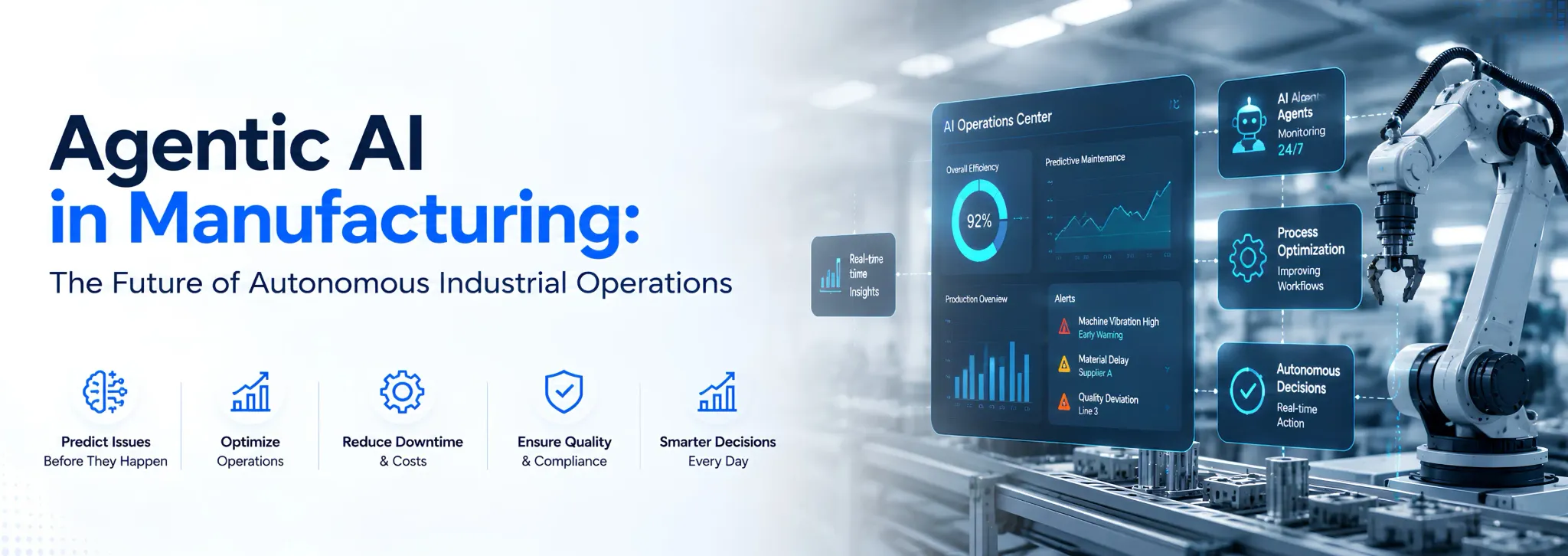
At 2:15 AM, inside a modern manufacturing plant, everything appeared normal.
Machines were running.
Production lines were moving.
Orders were being completed.
Employees were monitoring operations.
From the outside, it looked like another successful day in the factory.
But hidden inside thousands of data points, something had changed.
A machine vibration had increased slightly.
A supplier shipment was delayed.
Customer demand had shifted unexpectedly.
A quality pattern on one production line was slowly changing.
Each event seemed insignificant.
But experienced manufacturing leaders understand one important truth:
Small changes can create major consequences.
A small machine issue can become hours of downtime.
A minor supply chain disruption can affect an entire production schedule.
A quality variation can impact customer satisfaction and business reputation.
For decades, factories operated by reacting to problems.
A machine failed.
The maintenance team repaired it.
A production delay happened.
The schedule was adjusted.
A quality issue appeared.
The team searched for the solution.
Traditional automation in manufacturing helped factories improve speed and productivity, but most systems still depended on predefined instructions and human intervention.
Factories became better at responding.
But the next challenge was clear:
Could a factory identify problems before they happened?
Could it understand what was coming next?
Could it make smarter decisions before a disruption occurred?
That question started a new chapter in the future of manufacturing.
A New Intelligence Layer Enters the Factory
Imagine a chess match.
A beginner sees only the current move.
The opponent moves a piece, and they react.
But a chess champion sees beyond the present.
They analyze patterns.
They consider different possibilities.
They plan several moves ahead.
The difference is not just speed.
It is intelligence.
Modern factories are moving toward the same approach.
Instead of only reacting to events, manufacturers are building systems that can understand situations, predict outcomes, and recommend actions.
This is where agentic AI in manufacturing is changing the way industries operate.
Traditional manufacturing automation follows fixed rules.
A machine performs a specific task.
A system executes a programmed workflow.
A process continues based on predefined conditions.
However, modern factories generate massive amounts of information from machines, sensors, production systems, suppliers, and customers.
The challenge is no longer collecting data.
The challenge is understanding that data and deciding what action should happen next.
This is where AI agents in manufacturing become powerful partners.
AI agents bring intelligence into manufacturing operations by continuously analyzing information, identifying patterns, and supporting decision-making.
They can understand:
- What is happening inside the factory
- Why a problem is occurring
- What could happen next
- Which action can create the best outcome
With AI in manufacturing, factories are moving from simple automation toward intelligent and adaptive operations.

The Moment Before a Machine Failure
Imagine a machine working continuously on a production line.
A traditional system may alert the team after the machine stops.
By then, the problem has already affected operations.
Production has stopped.
Employees are waiting.
Orders are delayed.
Costs are increasing.
The factory is forced into emergency response mode.
But an AI-powered manufacturing system approaches the situation differently.
An AI agent continuously monitors machine performance.
It notices small signals:
The vibration level is increasing.
Energy consumption is becoming higher.
Temperature patterns are changing.
Production speed is slightly decreasing.
Similar patterns appeared before previous failures.
The AI agent connects these signals and predicts:
“This machine may experience a failure soon. Preventive maintenance should be scheduled.”
The maintenance team receives the recommendation.
The repair is planned at the right time.
Production continues.
The factory avoids unexpected downtime.
This is the power of predictive maintenance in manufacturing.
Instead of waiting for equipment failure, manufacturers can identify risks early and take preventive action.
From Manufacturing Automation to Autonomous Manufacturing
For years, manufacturing automation focused on improving speed, reducing manual work, and increasing efficiency.
Automation transformed factories.
Robots improved production.
Digital systems improved accuracy.
Software improved visibility.
But the next evolution is intelligent decision-making.
The combination of automation and artificial intelligence is creating a new model: intelligent manufacturing.
In an intelligent manufacturing environment, systems do more than execute tasks.
They understand processes.
They identify opportunities.
They recommend improvements.
They help teams make faster decisions.
This shift toward AI-powered manufacturing enables businesses to improve:
- Manufacturing efficiency
- Production planning
- Resource utilization
- Quality control
- Supply chain visibility
- Operational decision-making
The factory is no longer just automated.
It is becoming smarter.
How AI Agents Drive Manufacturing Excellence
For decades, Manufacturing Excellence was measured through traditional goals:
Produce more.
Reduce costs.
Improve speed.
Increase output.
These goals remain important.
But modern Manufacturing Excellence requires something more.
A successful factory must be adaptable.
It must respond quickly to changes.
It must identify risks before they become failures.
It must continuously improve operations.
This is where agentic AI in manufacturing supports a new definition of excellence.
AI agents help create operations that are:
- More predictive
- More flexible
- More efficient
- More data-driven
They support operational excellence in manufacturing by helping organizations make better decisions with real-time insights.
The factory of the future will not simply follow instructions.
It will understand its environment and improve continuously.
The Human Expert Still Controls the Game
A chess engine can analyze millions of possibilities.
But the greatest players still bring something technology cannot replace:
Experience.
Creativity.
Strategic thinking.
Manufacturing works the same way.
AI does not replace engineers, operators, or managers.
Instead, it gives them a clearer view of the entire operation.
An engineer can spend less time searching for problems and more time improving processes.
A production manager can spend less time reacting to failures and more time planning improvements.
Employees become strategic decision-makers supported by intelligent technology.
The combination of human expertise and artificial intelligence in manufacturing creates stronger, smarter operations.
The Smart Factory of Tomorrow Will Think Ahead
The factories of the past waited for problems.
The factories of today detect problems.
The factories of tomorrow will predict and prevent problems.
The rise of AI agents in manufacturing, agentic AI in manufacturing, and advanced manufacturing process automation is creating a new generation of smart factories.
These factories will:
Recognize patterns.
Learn from previous experiences.
Optimize operations.
Predict challenges.
Recommend better decisions.
This is the future of digital transformation in manufacturing.
The next generation of manufacturing will not be defined only by faster machines.
It will be defined by intelligent systems that understand, adapt, and improve.
The winners of tomorrow will not simply be the factories that react the fastest.
They will be the factories that can see the next move before anyone else.
Because the future of manufacturing belongs to those who do not just operate machines.
It belongs to those who build intelligent factories that think ahead.