


Every Monday morning, Rahul walked into his office carrying a cup of coffee and a long list of unfinished tasks. His team was already busy answering customer emails, processing invoices, updating spreadsheets, and manually approving requests. Although everyone worked hard, the day always ended with pending work.
Rahul often wondered,
“Why are we spending so much time on repetitive work instead of growing the business?”
If you’ve ever felt the same way, you’re not alone.
Thousands of businesses around the world face similar challenges. As organizations grow, so do their daily responsibilities. More customers bring more inquiries. More sales create more invoices. More employees mean more paperwork. Eventually, these routine tasks begin to consume valuable time that could be spent on innovation and business growth.
That is where AI Business Process Automation enters the picture.
Instead of relying entirely on manual work, businesses are now using artificial intelligence to automate repetitive processes, improve workflow efficiency, and make smarter decisions. The result is faster operations, reduced costs, and a better experience for both employees and customers.
Rahul decided it was time for a change.
The Turning Point
One afternoon, Rahul attended a business conference where several entrepreneurs shared how they had transformed their organizations using AI Workflow Automation.
One company reduced invoice processing from three days to just a few minutes.
Another automated customer support, allowing customers to receive answers instantly—24 hours a day.
An HR manager explained how employee onboarding, document verification, payroll, and task assignments had become almost effortless.
Listening to these success stories, Rahul realized something important.
Automation wasn’t replacing employees.
It was removing repetitive work so employees could focus on more meaningful responsibilities.
That simple realization completely changed his perspective.
What is AI Business Process Automation?
After returning to the office, Rahul wanted to understand exactly what AI Business Process Automation meant.
He discovered that traditional automation simply follows predefined rules.
For example:
- If a customer submits a contact form, send a confirmation email.
- If an invoice is approved, forward it to the accounting department.
Traditional automation performs repetitive tasks well, but it cannot think, learn, or adapt.
AI Business Process Automation goes much further.
Artificial intelligence can:
- Analyze business data
- Identify patterns
- Learn from previous activities
- Improve workflows over time
Instead of simply following instructions, AI helps businesses make better decisions while continuously improving operational efficiency.
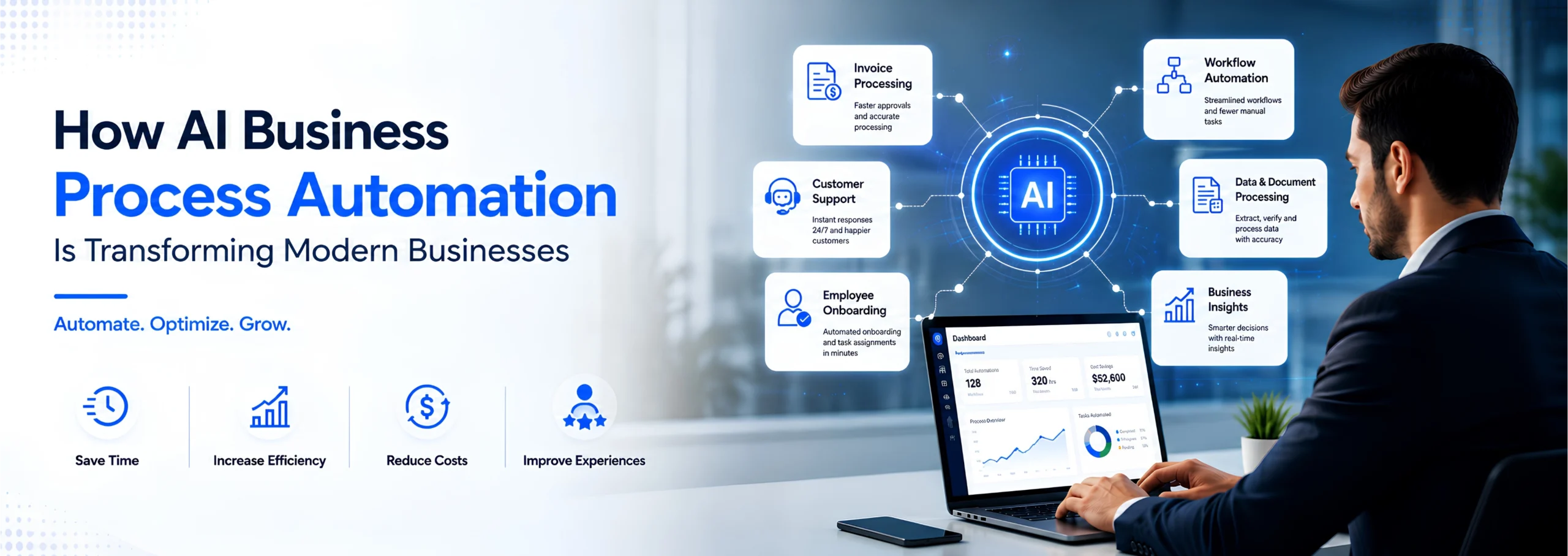
Today, organizations automate processes such as:
- Customer support
- Invoice processing
- Employee onboarding
- Sales workflows
- Inventory management
- Marketing campaigns
- Financial reporting
- Document processing
- Data entry
Once these repetitive activities are automated, employees have more time to focus on customers, innovation, and strategic growth.
Why Businesses Are Choosing AI Business Process Automation
Rahul soon realized that customer expectations had changed.
People expect faster responses, accurate services, and seamless experiences.
Businesses that continue relying on manual operations often struggle to keep pace.
That is why organizations across different industries are adopting AI Business Process Automation.
The benefits quickly became obvious.
Businesses can:
- Complete tasks faster.
- Reduce operational costs.
- Improve productivity.
- Increase process accuracy.
- Deliver better customer experiences.
- Make smarter business decisions.
- Scale operations without hiring large teams.
As Rahul’s business continued growing, the workload increased rapidly.
Instead of expanding his workforce immediately, he realized automation could handle many routine tasks efficiently.
How AI Workflow Automation Changed Daily Operations
Rahul didn’t automate everything at once.
He started with a few repetitive business processes.
The first improvement came in customer service.
Instead of making customers wait hours for responses, AI answered common questions immediately while forwarding complicated requests to human agents.
Next came invoice processing.
The AI system automatically verified purchase orders, detected duplicate invoices, and routed approvals to the appropriate managers.
Soon after, the HR department implemented AI Workflow Automation for employee onboarding.
New employees automatically received:
- Welcome emails
- Account creation
- Document verification
- Training schedules
- Task assignments
What once required several departments working together now happened within minutes.
Rahul’s team immediately noticed how much time they were saving.
The Results Were Impossible to Ignore
Only a few months later, the improvements were becoming obvious throughout the company.
Higher Productivity
Employees no longer spent hours performing repetitive administrative work.
Instead, they focused on solving customer problems, improving products, and developing new ideas that contributed directly to business growth.
Better Accuracy
Manual data entry mistakes became rare.
AI handled repetitive processes consistently, helping improve data quality and reducing costly human errors.
Business operations became more reliable and efficient.
Lower Operational Costs
As workloads increased, Rahul no longer needed to hire additional staff simply to handle repetitive work.
Instead, the company invested those savings into innovation, customer experience, and future growth.
Faster Decision-Making
One of Rahul’s biggest surprises was how quickly AI analyzed business information.
Managers could instantly understand:
- Sales performance
- Customer behavior
- Financial performance
- Inventory levels
- Operational efficiency
Instead of waiting days for reports, important decisions could now be made within minutes.
Improved Customer Experience
Customers noticed the difference almost immediately.
AI helped the company:
- Respond instantly to customer inquiries.
- Resolve issues more quickly.
- Offer personalized recommendations.
- Provide support 24 hours a day, seven days a week.
Happy customers became loyal customers.
As customer satisfaction improved, referrals increased, and the business continued growing.
Rahul finally understood that AI Business Process Automation wasn’t just about automating work.
It was about creating a smarter, faster, and more customer-focused business.
AI Across Different Industries
A few months after implementing AI Business Process Automation, Rahul attended another business event. This time, he wasn’t just listening—he was sharing his own success story.
During conversations with other business owners, he discovered something fascinating.
His company wasn’t the only one benefiting from AI.
Businesses across almost every industry were using Artificial Intelligence in Business to automate repetitive tasks, improve efficiency, and deliver better customer experiences.
No matter the industry, one goal remained the same—work smarter, not harder.
Healthcare
One hospital administrator explained how their organization had reduced administrative work using AI.
Healthcare providers now automate:
- Appointment scheduling
- Patient record management
- Insurance claim processing
- Medical data analysis
- Administrative workflows
Instead of spending hours on paperwork, healthcare professionals could dedicate more time to caring for patients.
Banking and Finance
Rahul also spoke with a finance executive who described how AI had transformed banking operations.
Financial institutions now automate:
- Loan approvals
- Fraud detection
- Risk assessment
- Customer support
- Financial reporting
By combining automation with intelligent decision-making, banks can process requests faster while improving security and reducing financial risks.
Manufacturing
A manufacturing company shared how production had become more efficient after implementing AI Workflow Automation.
Manufacturers use AI for:
- Production scheduling
- Quality inspections
- Predictive maintenance
- Supply chain management
- Equipment monitoring
Instead of waiting for equipment to fail, AI predicts maintenance needs before problems occur, reducing downtime and improving productivity.
Retail
Retail businesses have also embraced Artificial Intelligence in Business to create better shopping experiences.
Retailers automate:
- Inventory management
- Product recommendations
- Order processing
- Customer support
- Demand forecasting
This allows businesses to maintain accurate inventory while delivering personalized experiences that customers appreciate.
Human Resources
One HR manager smiled as she described how AI had simplified hiring.
Her team now automates:
- Resume screening
- Candidate matching
- Employee onboarding
- Payroll processing
- Performance reporting
Instead of spending days reviewing applications, recruiters could focus on selecting the right candidates and improving employee experiences.
Rahul realized that regardless of the industry, AI was helping organizations become faster, smarter, and more efficient.
Business Transformation Through AI
As Rahul reflected on his own journey, he realized something important.
The biggest change wasn’t automation.
The biggest change was transformation.
Before implementing AI, every department worked independently.
Sales waited for finance.
Finance waited for approvals.
HR managed paperwork manually.
Customer support struggled to answer every request.
Today, everything worked together.
The company experienced several major improvements.
Smarter Operations
AI provided complete visibility into business processes.
Managers could identify delays, monitor workflows, and improve efficiency continuously.
Data-Driven Decision Making
Gone were the days of relying on assumptions.
Instead, AI analyzed business data and provided valuable insights that helped leadership make informed decisions quickly.
Better Collaboration
Departments became more connected than ever before.
Sales, HR, finance, operations, and customer support shared information through automated workflows.
This reduced communication gaps and increased overall productivity.
Greater Innovation
Since employees no longer spent hours performing repetitive tasks, they had more time to:
- Solve customer problems
- Improve products and services
- Develop creative ideas
- Build stronger customer relationships
Rahul realized AI wasn’t replacing creativity.
It was creating more opportunities for creativity.
Every Success Story Has Challenges
Although the results were impressive, Rahul understood that implementing AI Business Process Automation wasn’t without challenges.
Every successful transformation required planning and preparation.
Initial Investment
The company invested in software, system integration, and employee training.
Although the initial cost seemed significant, the long-term savings quickly outweighed the investment.
Data Quality
Rahul learned that AI performs best when it has reliable information.
The company organized its business data before automating processes.
Accurate data produced better insights and more reliable automation.
Employee Training
Many employees initially worried that automation would replace their jobs.
Instead, Rahul explained that AI would eliminate repetitive work—not people.
The company provided training programs to help employees develop new digital skills.
Soon, employees realized AI made their work easier rather than replacing them.
Security and Compliance
Protecting business information remained a priority.
The company strengthened:
- Cybersecurity practices
- Data protection policies
- Access controls
- Compliance monitoring
These measures ensured business data remained safe while automation continued to expand.
Maximizing the Value of AI Workflow Automation
Rahul also discovered that successful automation requires a clear strategy.
Businesses achieve the best results when they follow a structured approach.
Identify Repetitive Tasks
The first step is identifying tasks that consume the most time.
Examples include:
- Data entry
- Report generation
- Responding to customer emails
- Invoice approvals
- Document processing
These activities often provide the quickest return on investment when automated.
Define Clear Goals
Every automation project should begin with measurable objectives.
Businesses commonly aim to achieve:
- Faster business processes
- Lower operational costs
- Better customer satisfaction
- Higher employee productivity
- Reduced manual errors
Clear goals help organizations measure success and continuously improve.
Start Small
Rather than automating every department immediately, Rahul introduced AI one process at a time.
This allowed employees to adapt comfortably while minimizing business disruption.
As confidence grew, additional workflows were automated.
Monitor Performance
Automation isn’t a one-time project.
Businesses should regularly monitor:
- Productivity
- Operational costs
- Customer satisfaction
- Error rates
- Overall efficiency
Continuous improvement ensures AI Workflow Automation continues delivering value as the business evolves.
Looking Toward the Future
One evening, Rahul looked around his office.
The atmosphere had completely changed.
Employees were collaborating instead of rushing through paperwork.
Managers focused on strategy instead of chasing reports.
Customers received faster responses than ever before.
Rahul smiled because he realized this was only the beginning.
The future of Artificial Intelligence in Business looks even more exciting.
Businesses will soon benefit from:
- Smarter workflow automation requiring minimal human intervention
- Predictive analytics that anticipate customer and business needs
- Faster data-driven decision-making
- Greater collaboration between humans and AI
- Fully automated departments handling routine operations
Companies that embrace AI Business Process Automation today will be better prepared for tomorrow’s opportunities.